What is one of the solutions to the following system of equations? y2 x2 = 65 y x = 7
JEE Previous twelvemonth set of questions on topic Arrangement of Linear Equations gives a articulate agreement of the topic. These solutions help in breaking down all the difficult problems by the simple step-by-step method of solving. BYJU'S provides accurate solutions, which are prepared past subject experts. This department deals with the solution of linear systems using different methods. How To Solve a Linear Equation System? Linear equations system can exist solved using different methods such as Graphical Method, Elimination Method, Cross Multiplication Method, Substitution Method, Matrix Method and Determinants Method. The set of all possible solutions is called the solution set. A linear system may comport in any i of 3 possible means: The organisation has no solution, a single unique solution or infinitely many solutions.
Students can easily admission and download chapter wise solutions in PDF format for free. Download Organization of Linear Equations solved questions PDF, from the link mentioned beneath.
Download System of Linear Equations Previous Year Solved Questions PDF
JEE Chief Past Yr Questions With Solutions on System of Linear Equations
Question i: Consider the system of equations x + y + z = 1, 2x + 3y + 2z = i, 2x + 3y + (a2 – 1)z = a + i then
(a) System has a unique solution for |a| = √3
(b) Organization is inconsistence for |a| = √3
(c) Organization is inconsistence for a = 4
(d) System is inconsistence for a = 3
Answer: (b)
Solution:
Given arrangement of linear equations:
x + y + z = 1 ….(1)
2x + 3y + 2z = 1 ….(two)
2x + 3y + (a2 – ane)z = a + ane …..(3)
Consider a2 – ane = 2
and so LHS of (2) and (three) are same just RHS are not.
Hence a2 = iii => |a| = √three
For |a| = √3, system is inconsistence.
So option (b) is correct.
Question 2: If the system of linear equations
2x + 2ay + az = 0
2x + 3by + bz = 0 and
2x + 4cy + cz = 0,
where a, b, c Є R are non-zip and singled-out; has non-zero solution, then
(a) a + b + c = 0
(b) i/a, 1/b, 1/c are in A.P.
(c) a, b, c are in A.P.
(d) a, b, c are in Grand.P.
Answer: (b)
Solution:
Given organisation of linear equations
2x + 2ay + az = 0
2x + 3by + bz = 0 and
2x + 4cy + cz = 0,
Now,
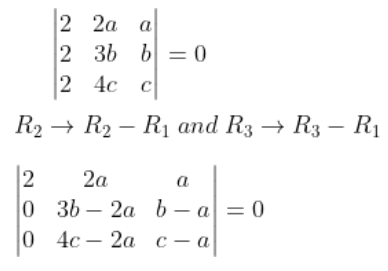
=> (3b − 2a)(c − a) − (4c − 2a)(b − a) = 0
=> 3bc − 2ac − 3ab + 2a2 − [4bc − 4ac − 2ab + 2a2] = 0
=> −bc + 2ac − ab = 0
=> ab + bc = 2ac
=> one/c + 1/a = 2/b
Which shows that one/a, 1/b, ane/c are in A.P.
Question 3: If system of linear equations
x + y + z = 6
x + 2y + 3z = 10 and
3x + 2y + λz = μ
has more 2 solutions, then μ − λii is equal to ________.
Solution:
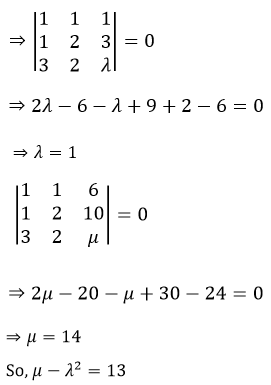
The system of equations has more than than 2 solutions.
Find for D = Diii = 0
Question four: For which of the following ordered pairs (μ, δ), the organization of linear equations
x + 2y + 3z = 1
3x + 4y + 5z = μ
4x + 4y + 4z = δ
is inconsistent?
(a) (4, 6) (b) (3, 4) (c) (ane, 0) (d) (4, three)
Reply: (d)
Solution:
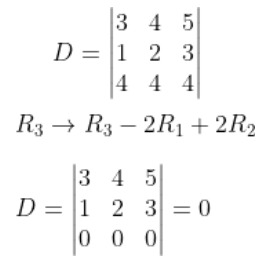
For inconsistent system, 1 of Dx, Dy, Dz should not be equal to 0.
Now,
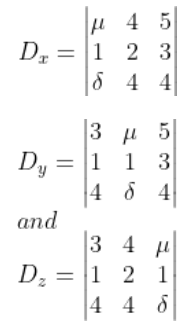
For inconsistent organisation, 2μ ≠ δ + ii
Therefore, the arrangement will be inconsistent for μ = 4, δ = 3.
Question five: The organization of linear equations
λx + 2y + 2z = 5
2λx + 3y + 5z = 8
4x + λy + 6z = 10 has:
(a) no solution when λ = 2
(b) infinitely many solutions when λ = 2
(c) no solution when λ = 8
(d) a unique solution when λ = -viii
Answer: (a)
Solution:
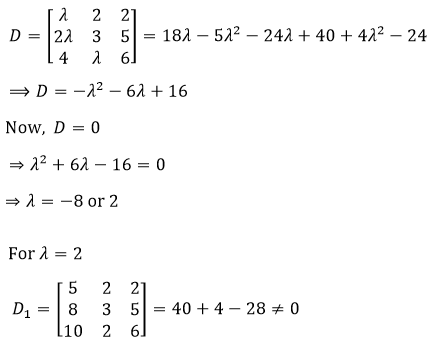
Therefore, Equations have no solution for λ= two.
Question 6: The following system of linear equations
7x + 6y − 2z = 0 ,
3x + 4y + 2z = 0
x − 2y − 6z = 0, has
(a) infinitely many solutions, (x, y, z) satisfying y = 2z
(b) infinitely many solutions, (x, y, z) satisfying x = 2z
(c) no solution
(d) just the piffling solution
Answer: (b)
Solution:
Given arrangement of linear equations
7x + 6y − 2z = 0 ,
3x + 4y + 2z = 0
x − 2y − 6z = 0,
Equally the arrangement of equations are Homogeneous
=> The organization is consistent.
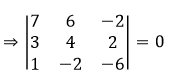
=> Infinite solutions be (both trivial and non-trivial solutions)
When, y = 2z
Let's have y = two and z = i
When (x, 2, i)is substituted in the system of equations
=> 7x + x = 0,
3x + ten = 0 and
x − 10 = 0 (which is not possible)
Therefore, y = 2z
=> Infinitely many solutions not be.
For ten = 2z, let's take x = 2, z = 1, y = y
Substitute (2, y, 1) in system of equations
=> y = −ii
So, for each pair of (x, z), we get a value of y.
Therefore, for x = 2z infinitely many solutions exist.
Question 7: If the system of linear equations
x + ky + 3z = 0
3x + ky – 2z = 0 and
2x + 4y – 3z = 0
has a non aught solution (10, y, z) then xz/ytwo is equal to
(a) -ten (b) 10 (c) -xxx (d) 30
Answer: (b)
Solution:
Given system of linear equations
x + ky + 3z = 0
3x + ky – 2z = 0 and
2x + 4y – 3z = 0
System has not zero solution, and so
D = 0
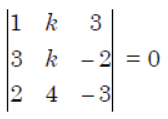
1(-3k + 8) – k(-9 + iv) + iii(12 – 2k) = 0
Solving higher up equation, we accept -4k = -44
or grand = 11
x + 11y + 3z = 0 …(i)
3x + 11y – 2z = 0 …..(ii)
2x + 4y – 3z = 0 ….(iii)
Solving (i) and (iii)
x = -5y
Using x = -5y in (3), -10y + 4y – 3z = 0
-6y – 3z = 0
or z = -2y
At present, xz/ytwo = (-5y)(-2y)/y2 = ten
Question 8: The number of existent values of λ for which the system of linear equations
2x + 4y − λz = 0
4x + λy + 2z = 0
λx + 2y + 2z = 0
has infinitely many solutions, is :
(a) 0 (b) 1 (c) 2 (d) 3
Reply: (b)
Solution:
For infinitely many solutions, D = 0, Dx = 0, Dy = 0 and Dz = 0
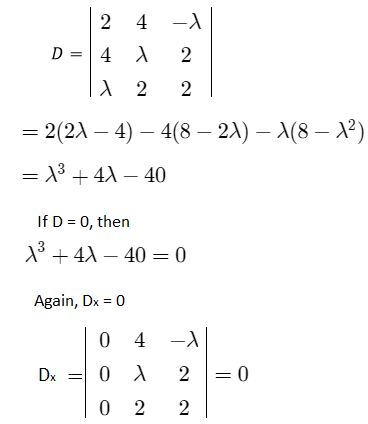
Similarly, Dy = 0 and Dz = 0
The equation, λiii + 4λ – 40 has only one solution.
Since λ(-∞) = -∞ and λ(∞) = ∞
Hither α is only i solution, so λ(α) = 0
[Using intermediate value holding]Now, differentiating λ3 + 4λ – 40 w.r.t. λ we get
3λtwo + four > 0
The equation can not have y, m, and so
λ(thou) = 0 and λ(y) = 0
Thus, the number of real values of λ is 1.
Question 9: If ten = a, y = b, z = c is a solution of the organisation of linear equations
x + 8y + 7z = 0
9x + 2y + 3z = 0
x + y + z = 0
such that the point (a, b, c) lies on the plane x + 2y + z = 6, then 2a + b + c equals :
(a) −ane (b) 0 (c) 1 (d) two
Reply: (c)
Solution:
Given system of linear equations
ten + 8y + 7z = 0 …(i)
9x + 2y + 3z = 0 ….(two)
10 + y + z = 0 ….(iii)
Operate: (ii) – 3 x (iii)
6x – y = 0 or y = 6x …..(iv)
Using (4) in (i)
x + 8(6x) + 7z = 0
z = -7x ……(5)
Since x = a, y = b, z = c (Given)
b = 6a and c = -7a
Besides, (a, b, c) lies on the plane x + 2y + z = 6.
Therefore, a + 2b + c = vi …..(vi)
Putting the values of b and c in (vi),
a + 2(6a) – 7a = half-dozen
=> a = 1
Also, nosotros get b = six and c = -7
Now, 2a + b + c = 2(1) + vi – vii = 1
Question x: It S is the set of distinct values of 'b' for which the following system of linear equations x + y + z = 1 x + ay + z = ane ax + by + z = 0 has no solution, so S is :
(a) an empty gear up
(b) an space gear up
(c) a finite set containing two or more than elements
(d) a singleton
Reply: (d)
Solution:
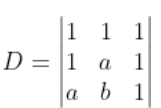
= -(a – one)ii = 0
=> a = i
Nosotros get get-go 2 planes co-incident for a = 1.
x + y + z = 1
x + y + z = 1
x + by + z = 0
If b = 1, the arrangement will be inconsistent and hence no solution.
If b ≠ one, the system will produce infinite solutions.
Hence, for no solution, Southward has to be a singleton set {1}.
As well Read
JEE Advanced Maths Affiliate-wise Previous Twelvemonth Questions With Solutions
Source: https://byjus.com/jee/jee-main-system-of-linear-equations-previous-year-questions-with-solutions/
0 Response to "What is one of the solutions to the following system of equations? y2 x2 = 65 y x = 7"
Post a Comment