How Does Egg Protein Compare to Beef
 by Victoria Mazmanyan | Last updated on November 15, 2021
Education: General Medicine at YSMU

vs

Summary
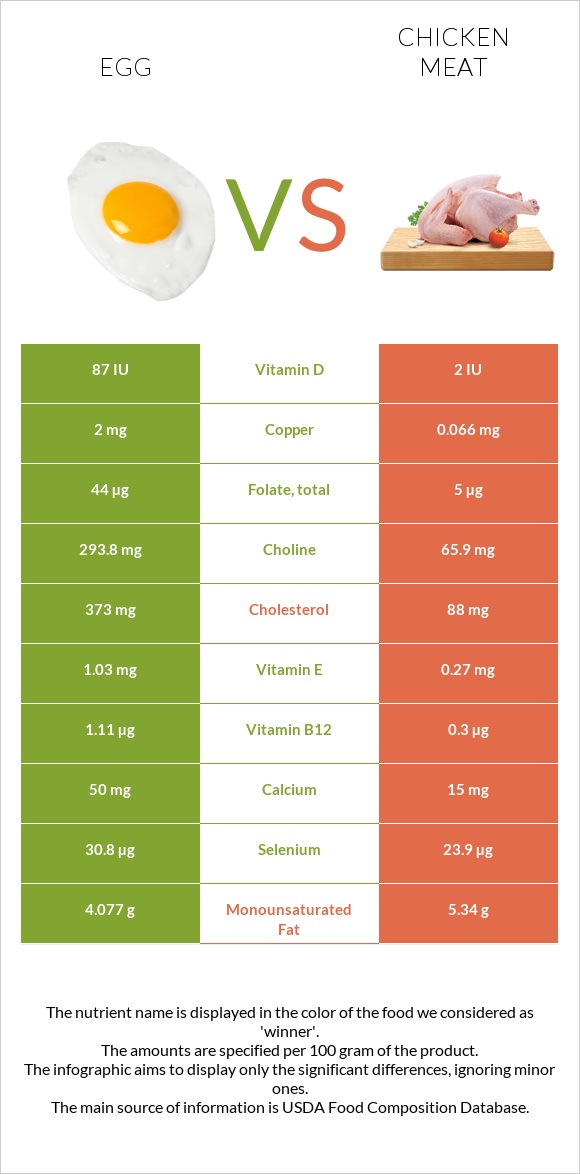
Chicken meat is denser in most nutrients, being significantly higher in calories, protein, and fats. Chicken contains 132 times more vitamin B3.
Eggs, however, are 30 times higher in copper, 9 times richer in folate, and provide vitamin D, unlike chicken meat.
Table of contents
- Introduction
- Egg White and Yolk
- Varieties and Classifications
- Nutrition
- Macronutrients and Calories
- Calories
- Protein
- Fats
- Carbohydrates
- Vitamins
- Minerals
- Glycemic Index
- Acidity
- Weight Loss & Diets
- Health Impact
- Health Benefits
- Cardiovascular Health
- Diabetes
- Cancer
- Downsides and Risks
- Cardiovascular Health
- Diabetes
- Cancer
- Allergy
- Salmonella poisoning
- Sources.
Introduction
The chicken or the egg debate has been a subject of interest for millennia. Plutarch first posed this question in his philosophical essays as early as the 1st century (1). Today, we will look at this question from a scientific perspective. However, instead of answering the question of which came first, we will look at which is better.
Egg White and Yolk
When talking about the nutrition of eggs, it is essential to note the significant nutritional differences between egg white and yolk.
On average, the egg content is said to consist of 67% egg white and 33% yolk by weight.
Egg yolk is significantly richer in nearly all nutrients, including protein, fats, and most vitamins and minerals.
To get more detailed information about the differences between egg white and yolk, you can visit this page.
This article will be discussing the nutritional values of a whole egg
Varieties and Classifications
Chicken meat is classified as poultry and white meat due to the relatively lower iron and myoglobin levels.
Naturally, egg as food can refer to the eggs laid by many different animals, such as chicken, duck, quail, turkey, and many others. However, this article will discuss the eggs laid by female chickens.
Depending on the cooking method, the variety, and the production method, the physicochemical and nutritional properties of eggs and chickens can significantly differ.
Chicken meat can be sold in fresh or processed forms. The chickens can also be domesticated or wild. Based on these, the health impact of the chicken can vary.
Depending on the different cuts, chicken meat can be sold as the breast, the wing, and the leg.
The USDA classification of chickens is based on the age and extent of breastbone calcification (2). Some of the classes of chickens are:
- Cornish game hen
- Broiler-fryer
- Roaster
- Capon
- Hen, fowl, or baking chicken
The USDA classification of eggs, on the other hand, is based on their size and divided into five groups (3).
- Small: 43g (1.5oz)
- Medium: 50g (1.75oz)
- Large: 57g (2oz)
- Extra-large: 64g (2.25oz)
- Jumbo: 71g (2.5oz)
Nutrition
For this article, we will be comparing the nutritional values of a whole, hard-boiled egg and a roasted broiler or fryer chicken with meat and skin.
As these two foods come in vastly different shapes and forms, we will discuss the nutritions based on a serving size of 100g, equal to a 3.5oz slice of chicken and two medium eggs.
Macronutrients and Calories
Unsurprisingly, chicken meat is overall denser in nutrients compared to a chicken egg. Chicken contains 59% water and 41% nutrients, while eggs contain 75% water and 25% nutrients.
Calories
While both of these foods can be considered to be high-calorie foods, chicken breast is notably higher in calories.
Equal 100g servings of chicken meat and egg contain 239 and 155 calories, respectively.
Chicken wings are higher in calories than chicken breast; however, the difference is not significant.
On the other hand, egg yolk is substantially higher in calories compared to egg white.
Protein
Both of these foods are excellent protein sources; however, chicken meat is over two times richer in protein compared to eggs. A 100g chicken contains 27.3g of protein, while the same serving size of eggs provides 12.6g of protein.
The protein found in these foods is of high quality as chicken and eggs contain high levels of all essential amino acids.
While chicken is richer in all essential amino acids, it is particularly higher in threonine, lysine, and histidine.
Fats
While chicken meat is also higher in fats, the difference is relatively small. A 100g of chicken contains 13.6g of fats, only 3g more than the same amount of eggs.
The fat found in chicken meat is also of a preferable quality, as it contains less saturated fats but more polyunsaturated fats.
Egg's fat content consists of 37% saturated, 47% monounsaturated, and 16% polyunsaturated fats. Chicken fat contains 31% saturated, 44% monounsaturated, and 25% polyunsaturated fats.
Eggs are substantially higher in cholesterol, containing over four times more of it. A 100g serving of eggs contains 373mg of cholesterol, while the same amount of chicken has only 88mg.
Carbohydrates
Like most meat, chicken does not contain a notable amount of carbohydrates.
Eggs contain only 1.1g of carbohydrates in a 100g serving.
Vitamins
Eggs are overall richer in more vitamins compared to chicken meat.
Eggs are rich in vitamin D, which chicken meat lacks completely. Eggs provide 9 times more folate and over 3 times more vitamin A, vitamin E, vitamin B2, and vitamin B12. Eggs are slightly higher in vitamin B5 as well.
At the same time, chicken meat is 132 times richer in vitamin B3. Chicken also contains 8 times more vitamin K and 3 times more vitamin B6.
Chicken and eggs contain similar amounts of vitamin B1, and both are absent in vitamin C.
Vitamin Comparison
Vitamin comparison score is based on the number of vitamins by which one or the other food is richer. The "coverage" chart below show how much of the daily needs can be covered by 300 grams of the food
8
:
3
Contains more Vitamin A +223%
Contains more Vitamin E +281.5%
Contains more Vitamin D +∞%
Contains more Vitamin B2 +205.4%
Contains more Vitamin B5 +35.7%
Contains more Folate +780%
Contains more Vitamin B12 +270%
Contains more Vitamin B3 +13160.9%
Contains more Vitamin B6 +230.6%
Contains more Vitamin K +700%
Equal in Vitamin B1 - 0.063
Contains more Vitamin A +223%
Contains more Vitamin E +281.5%
Contains more Vitamin D +∞%
Contains more Vitamin B2 +205.4%
Contains more Vitamin B5 +35.7%
Contains more Folate +780%
Contains more Vitamin B12 +270%
Contains more Vitamin B3 +13160.9%
Contains more Vitamin B6 +230.6%
Contains more Vitamin K +700%
Equal in Vitamin B1 - 0.063
Minerals
Both chicken and eggs provide satisfactory amounts of minerals.
Eggs contain over 3 times more calcium, 4 times more choline, and 30 times more copper. Eggs also contain more selenium.
On the other hand, chicken meat provides nearly 2 times more magnesium, zinc, and potassium. Chicken is also slightly higher in iron and phosphorus.
Chicken and eggs are both similarly low in manganese.
Chicken is lower in sodium, containing 82mg of it, while eggs contain 124mg.
Mineral Comparison
Mineral comparison score is based on the number of minerals by which one or the other food is richer. The "coverage" chart below show how much of the daily needs can be covered by 300 grams of the food
2
:
6
Contains more Calcium +233.3%
Contains more Copper +2930.3%
Contains more Magnesium +130%
Contains more Potassium +77%
Contains less Sodium -33.9%
Contains more Zinc +84.8%
Equal in Iron - 1.26
Equal in Phosphorus - 182
Contains more Calcium +233.3%
Contains more Copper +2930.3%
Contains more Magnesium +130%
Contains more Potassium +77%
Contains less Sodium -33.9%
Contains more Zinc +84.8%
Equal in Iron - 1.26
Equal in Phosphorus - 182
Glycemic Index
The glycemic index of both chicken meat and eggs is considered to be 0 due to the lack of carbohydrate content (4).
However, the glycemic index of processed chicken has been demonstrated to be much higher. Chicken nuggets have a glycemic index of 46±4 (5). This glycemic index value still falls in the low category.
If interested, you can get more information about the glycemic index of chicken meat and eggs.
Acidity
Fresh chicken meat has a pH value falling in the range of 5.8 to 6.3, making it acidic (6). This value is higher when the meat is fresh and gets more acidic as time goes on (7).
On the other hand, when stored in the refrigerator, fresh eggs have an average pH of 7.5, making them slightly alkaline. However, the pH of eggs increases to be more alkaline at warmer temperatures and when stored for an extended period (8).
The potential renal acid load or the PRAL value of foods is a different way of measuring acidity.
The PRAL values for chicken meat and eggs are 14.6 and 9, respectively. The higher this number is, the more acid-producing the food is inside the body.
To sum up, chicken meat is more acidic and more acid-producing than a chicken egg.
Weight Loss & Diets
Chicken meat and egg are high-calorie foods. However, due to the high protein content, these two fit into a variety of different diets.
Between these two, eggs are the better choice for low-fat and low-calorie diets, while chicken meat is the relatively better option for a low-carb diet.
Due to the rich and high-quality protein content, eggs and chicken are often included in weight-gain and muscle-building diets.
However, despite the high caloric content, eggs and chicken meat have also been researched to help reduce the risk of developing extra fat and obesity (9, 10).
Naturally, eggs fit into a vegetarian diet, but not a vegan diet, while chicken meat cannot be consumed on both of these diets.
Both eggs and chicken meat are great sources of protein on keto and Mediterranean diets.
Health Impact
We talked about the beneficial nutrients of eggs and chicken meat, such as protein, minerals, and vitamins. In this section, we will discuss how these nutrients affect the human body based on scientific studies.
Health Benefits
Cardiovascular Health
Research has shown a strong inverse association between unprocessed white meat, including chicken, and all-cause mortality. This study also shows chicken consumption to have a neutral association with cardiovascular disease and mortality (11).
Despite the high cholesterol content, the consumption of one egg per day has not been associated with incident cardiovascular disease risks, such as the risk of coronary heart disease and stroke. In Asian populations, moderate consumption of eggs was even associated with a lowered cardiovascular disease risk (12).
Research has suggested that dietary cholesterol, as part of a healthy diet, is a required nutrient that does not negatively impact blood lipids (13).
Diabetes
The consumption of poultry meat, including chicken, as part of a vegetable-rich diet, is associated with a reduced risk of developing not only overweight, obesity, cardiovascular diseases, but also type 2 diabetes mellitus (9).
Other than the type of meat, preparation methods also play a role in the impact on health. It has been shown that cooking meat at high temperatures, such as grilling and barbecuing, increases the risk of type 2 diabetes as opposed to cooking at moderate temperatures, such as boiling, steaming, and stir-frying (14).
Some research has concluded that moderate egg consumption is not associated with the development of type 2 diabetes (15).
Cancer
Intake of white meat, particularly poultry, is considered to have a moderately protective or neutral effect on cancer risk (9).
Chicken consumption has been correlated with reduced risk of esophageal, gastric, and lung cancers while having no association with colorectal and breast cancers (9).
A moderate intake of eggs may have a cancer-protective effect as several egg proteins have been researched to cause apoptosis in cancer cells, protect against DNA damage, decrease the spread of cancer cells, and display cytotoxic, antimutagenic activity in various cancer cell lines (16).
Downsides and Risks
When prepared incorrectly and in high quantities, these same foods may contrastingly harm health, especially eggs.
Cardiovascular Health
Contrary to the previous statements, other studies have found that not only processed and red meat but also unprocessed poultry, such as chicken, is associated with an increased risk of incident cardiovascular disease (17, 18).
Diabetes
As opposed to chicken, high but not moderate levels of daily egg consumption, such as more than one egg per day, have been associated with an increased risk of type 2 diabetes in both men and women (19).
The possible mechanisms for this adverse effect are the levels of inflammatory choline found in egg yolk and the slowed carbohydrate absorption from egg whites.
Cancer
A higher intake of eggs may lead to an increased risk of developing cancer, including cancers of the oral cavity, pharynx, colorectum, lung, breast, prostate, and bladder (20).
Allergy
Unlike chicken meat allergy, egg allergy is one of the most common allergies. Egg allergy is the second most common allergy found in children after cow's milk allergy (21).
Five main allergens have been found in the egg's protein (21).
Chicken meat and egg allergy express similar symptoms and can range from a cough and a rash to an anaphylactic shock in rare cases.
Salmonella poisoning
Live poultry, such as chicken, can carry the Salmonella bacteria and pass it on to the egg, becoming a common source of food-borne poisoning.
To avoid a Salmonella infection, the correct keeping and preparing of both eggs and chicken meat is essential.
Eggs and chicken are to be kept in the refrigerator at 40°F (4°C) or colder. Chicken meat should be prepared to an internal temperature of 165°F (74°C), while egg dishes should be cooked to an internal temperature of 160°F (71°C) (22).
Sources.
- https://www.gutenberg.org/files/3052/3052-h/3052-h.htm
- https://www.ams.usda.gov/sites/default/files/media/PoultryStandard.pdf
- https://www.ams.usda.gov/sites/default/files/media/Shell_Egg_Standard%5B1%5D.pdf
- https://academic.oup.com/ajcn/article/93/5/984/4597984
- https://care.diabetesjournals.org/content/diacare/suppl/2008/09/18/dc08-1239.DC1/TableA1_1.pdf
- https://iopscience.iop.org/article/10.1088/1755-1315/102/1/012051/pdf
- https://www.researchgate.net/publication/12835390
- http://www.doiserbia.nb.rs/img/doi/1450-9156/2016/1450-91561603285M.pdf
- https://www.ncbi.nlm.nih.gov/pmc/articles/PMC4462824/
- https://www.ncbi.nlm.nih.gov/pmc/articles/PMC2755181/
- https://www.mdpi.com/2072-6643/13/2/676/pdf
- https://www.bmj.com/content/368/bmj.m513
- https://www.ncbi.nlm.nih.gov/pmc/articles/PMC6682969/
- How Meat Is Cooked May Affect Risk of Type 2 Diabetes
- https://www.researchgate.net/publication/243964735
- https://www.sciencedirect.com/science/article/pii/S0032579119579585
- https://jamanetwork.com/journals/jamainternalmedicine/fullarticle/2759737
- https://academic.oup.com/eurheartj/article/42/12/1136/6032616
- https://www.ncbi.nlm.nih.gov/pmc/articles/PMC2628696/
- https://pubmed.ncbi.nlm.nih.gov/20104980/
- https://www.ncbi.nlm.nih.gov/pmc/articles/PMC3069662/
- https://www.cdc.gov/foodsafety/communication/salmonella-food.html

Education: General Medicine at YSMU
Last updated: November 15, 2021
Infographic
Which food is preferable for your diet?

is better in case of low diet
| | | |
| Low Fats diet | | |
| Low Carbs diet | | |
| Low Calories diet | | |
| Low glycemic index diet | Equal | |
People also compare
Vitamin and Mineral Summary Scores
The summary score is calculated by summing up the daily values contained in 300 grams of the product. Obviously the more the food fulfills human daily needs, the more the summary score is.
Vitamin Summary Score
45
36
Mineral Summary Score
108
31
Macronutrients Comparison
Macronutrient comparison charts compare the amount of protein, total fats, and total carbohydrates in 300 grams of the food. The displayed values show how much of the daily needs can be covered by 300 grams of food.
Protein
75%
164%
Carbohydrates
1%
0%
Fats
49%
63%
Comparison summary
Which food is lower in Saturated Fat?
Egg is lower in Saturated Fat (difference - 0.523g)
Which food is richer in vitamins?
Egg is relatively richer in vitamins
Which food is lower in Sugar?
Chicken meat is lower in Sugar (difference - 1.12g)
Which food contains less Sodium?
Chicken meat contains less Sodium (difference - 42mg)
Which food is lower in Cholesterol?
Chicken meat is lower in Cholesterol (difference - 285mg)
Which food is lower in glycemic index?
?
The foods have equal glycemic indexes (0)
Which food is cheaper?
?
The foods are relatively equal in price ($1)
Which food is richer in minerals?
?
It cannot be stated which food is richer in vitamins. See the charts below for detailed information. See the charts below for detailed information. See the charts below for detailed information.
Source: https://foodstruct.com/compare/egg-vs-chicken-meat
0 Response to "How Does Egg Protein Compare to Beef"
Post a Comment